Why GPS Clocks Need Relativity Corrections
Without correction, position errors of roughly 11.4 kilometers per day would accumulate.
How GPS Builds Relativistic Corrections into Satellite Timekeeping
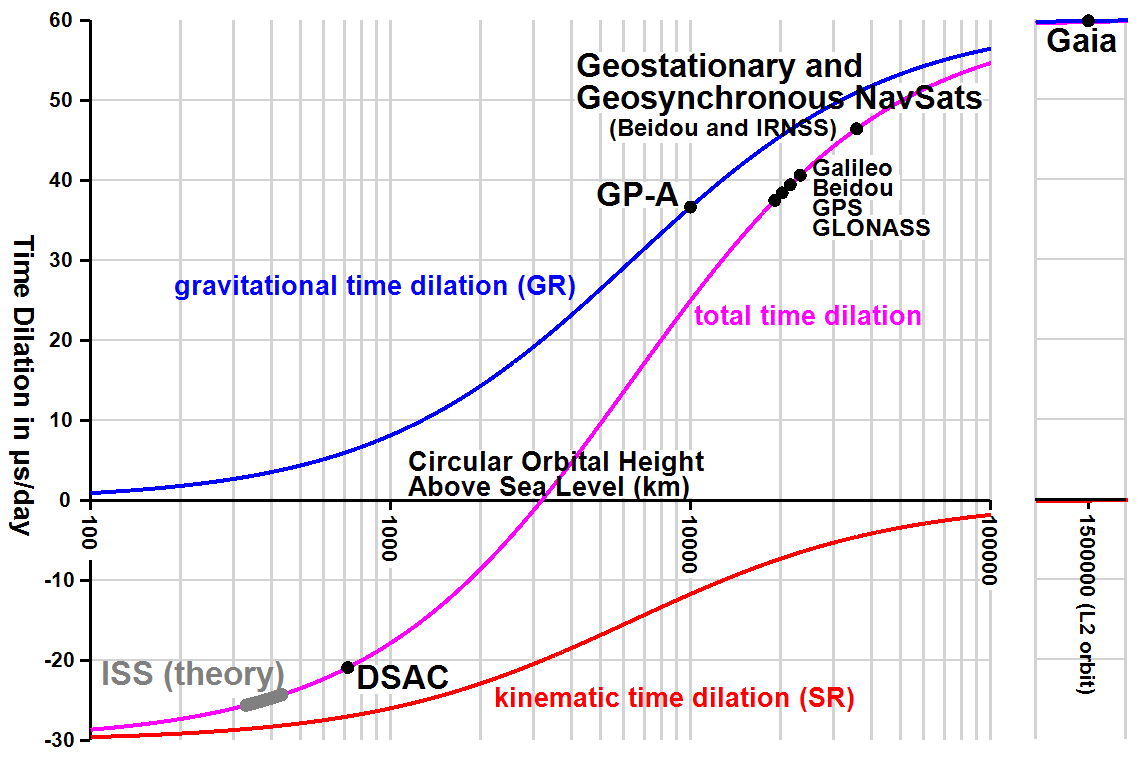
Before launch, the frequency standard aboard each GPS satellite receives a rate offset that makes it run slightly slower than the frequency desired on Earth. It is set to 10.22999999543 MHz rather than 10.23 MHz. After launch, gravitational and motional frequency shifts affect the clock rate. Special and general relativity predict that GPS satellite clocks, as observed by clocks on Earth, run 38 microseconds faster per day than clocks on Earth. The prelaunch frequency offset compensates for this discrepancy and allows the orbiting clock to approach the desired frequency when operating in space. Periodic corrections are also made to the onboard clocks to keep them synchronized with clocks on the ground.
How Signal Timing Determines a Receiver’s Position
Conceptually, a GPS receiver measures the times of arrival of signals from four satellites according to its own clock. It compares those arrival times with the signals’ times of transmission to form four time-of-flight values. Given the speed of light, each value is approximately equivalent to the range between the satellite and receiver, plus the time difference between the receiver and GPS satellites multiplied by the speed of light. These values are called pseudo-ranges.
The receiver uses the four time-of-flight values to compute its three-dimensional position and its clock deviation. Correcting for that difference eliminates the need for a more precise and possibly impractical receiver-based clock.
Why Speed and Gravity Produce a Net Gain of 38 Microseconds per Day
Special relativity predicts that, in a given frame, time slows as an object’s velocity increases. Atomic clocks moving at GPS orbital speeds therefore tick more slowly than stationary clocks. Clocks deeper in the gravitational potential well, closer to the attracting body, tick more slowly. GPS receivers are closer to Earth’s center than the satellites, so clocks at satellite altitude run faster by a factor of 5 × 10⁻¹⁰, or about 45.8 microseconds per day. This gravitational frequency shift is measurable.
The effects work in opposite directions. Orbital motion slows the satellite clocks through special relativity, while their greater distance from Earth speeds them through gravitational time dilation. Combined, these effects cause satellite clocks to gain about 38 microseconds per day relative to clocks on the ground. Without correction, position errors of roughly 11.4 kilometers per day would accumulate. The initial pseudorange error is corrected while solving the navigation equations.
Satellite orbits are elliptical rather than perfectly circular, so their altitude changes. As a result, time dilation and the gravitational frequency shift vary with time. This eccentricity effect causes the clock-rate difference between a GPS satellite and a receiver to increase or decrease depending on the satellite’s altitude.
Key facts
- Effect of orbital motionSpecial relativity predicts that orbital motion slows satellite clocks.
- Effect of weaker gravityClocks at GPS satellite altitude run about 45.8 microseconds per day faster than clocks closer to Earth’s center.
- Net clock-rate differenceThe combined effects cause satellite clocks to gain about 38 microseconds per day relative to clocks on the ground.
- Prelaunch frequency settingEach satellite’s frequency standard is set to 10.22999999543 MHz rather than 10.23 MHz before launch.
Sources
How we check our articles: see our editorial standards. Spotted an error? Tell us and we will correct it.